Friday, 3 January 2014

Bits and Bobs


part of a large gull flock off Straight Point


black redstart in classic beach 'n' boulder habitat


I did a short sea-watch from the raised beach huts just beyond the lifeboat station from 0810 - 0920. Lu and the kids were still getting up when I got back which is always good because they've not really missed me! The waves were crashing over the road - something I've not seen before, though this happens often enough further along the seafront towards the docks. Birds included the 2 female eider close offshore, 50+ gannet, 5 fulmar (all pale birds), 35+ kittiwake, 19 auk sp, 1 guillemot, 1 great northern diver, 5 diver sp, 2 dark-bellied brent goose, 1 duck sp (prob long-tailed), 1 velvet scoter  and 1+ common gull. I was fully expecting to get at least one bonxie but in the limited time I had it wasn't to be.
This afternoon I nipped down to Sandy Bay to look through the large number of gulls that's feeding along the beach but I couldn't find anything unusual among them. I had better luck right beneath the cliffs of Straight Point, just at the end of the access ramp where a load of detritus has been forced into a corner. At least 2 rock pipit, 10 turnstone, a robin, 2 pied wagtail and a lovely black redstart were busily feeding in relative shelter from the ferocious gale.

Thursday, 2 January 2014

Jan 1st - 2nd


Yesterday I walked the dog from the lifeboat station to Sandy Bay. The weather was horrendous but the miserable conditions meant I pretty much had the beach to myself. This group of dark-bellied brents were the only birds of note although there was a decent gathering of large gulls spread along the beach. Terry Smith fared better with a bonxie along the seafront.
Birding is usually more productive in the aftermath of a storm so I spent the first couple of hours of daylight this morning at Orcombe Point with totals as follows: 1 razorbill, 2 red-throated diver, 3 common scoter, 9 diver sp, 6 auk sp, 1 great crested grebe, 1+ curlew, c40/50+ skylark, c40+ linnet, c10/20+ meadow pipit, 18+ snipe, 1 jack snipe, 1+ turnstone, 2 great northern diver, 2 eider and 1 pied wagtail. I'm always pleased to see jack snipe. This morning's bird was in the top fields on private land. It is a species that I now expect annually though I've had more autumn than winter records presumably because I don't do Orcombe much in the winter. The fields are obviously pretty wet at the moment so I'm hoping for more.
Late this afternoon I nipped down to Exmouth Docks and was pleased to pick up the long-staying adult bonaparte's gull. It was with a couple black-headed gulls on Bull Hill so it was distant. The last time I saw this particular bird was on Exmouth beach on July 18th 2011! It was initially found by Chris Townend on the Otter estuary on April 13th 2011.

Tuesday, 31 December 2013

Diver 'n' Glauc

I should have gone for the diver before but the brunnich's guillemot, family life and apathy kind of got in the way. I've seen white-billed diver before but 'need' it for Devon. The problem is I'm not that fussed about my Devon list and Brixham is a fair old trek from Exmouth. I do of course love seeing rare birds regardless of whether I've seen them before so I finally headed down to Brixham first thing this morning and I'm really glad I did. The diver was first picked up in the inner harbour by a couple other birders so a short walk ensued before I clapped eyes on it - a tremendous bird with a mammoth 'banana' bill. I did a couple sketches but it was raining and my fingers got frozen so not much was achieved - see below (colour added at home).


I then got a call from Mike who was on the opposite side of the harbour so we met back at the breakwater and went in search of the black guillemot. Bionic-eyed Mike almost immediately got on the darker of the two birds that has moved across from Hope's Nose. It showed down to a few feet!


The heavy black markings on the wing coverts of this individual are noteworthy but it's presumably within normal range of variation for black guillemot. Mike then picked up the first winter iceland gull on the opposite side of the harbour and everywhere we looked there were divers - absolutely fantastic!


black-throated diver - 1 of four in the harbour

So totals for Brixham harbour were: white-billed diver, c5/10+ great northern diver, 4 black-throated diver, long-tailed duck, 4+ turnstone, 4 purple sandpiper, rock pipit, fw black guillemot, juv iceland gull, 1 guillemot and 2 razorbill.
I was supposed to then head straight home after Brixham but I couldn't resist a quick look at the Teign estuary - a place that still holds a place in my heart. A place where I cut my birding teeth, spending countless hours in sub-zero temperatures seeing very little!
After a number of scans from Lower (I think) Netherton Lane I fixed on a large gull facing me, stood amongst great black-backed gulls. It turned its head sideways to reveal a pink bill tipped black - it could only be a glaucous gull. I hurriedly walked downriver and was soon able to confirm it as a juv glaucous gull and a gigantic one at that, dwarfing the great black-backs! 


Gives some idea of size next to great black-backs


I birded the Teign for years but didn't see too many glaucous gulls, even when Fosterville tip was drawing the gulls in. I can't think of too many occasions when I've seen both 'white-wingers' in Devon on the same day so the odds are there will be more turning up in the next few days.
Great to catch up with Mike Langman and Mark Bailey today and a big thank you to Bill McDonald for finding the diver - a Devon 'biggie'!


Sunday, 29 December 2013

Half Mile Velvet

I spent a bit of time on Orcombe early this morning. My Orcombe patch includes Maer Rocks which is where I do most sea-watching from (see the 'Patch' page for the boundaries I use). It was a clear morning so the sunrise was beautiful, prompting me to try some arty shots. They look much better on the back of my camera than on the computer screen though which is really annoying. Birds seen included 69+ brent goose, 6+ turnstone, the 2 female eider, 1 red-throated diver, 1 great crested grebe, the female velvet scoter, 2 mistle thrush and 3 song thrush.


Looking east'ish from the tip of Orcombe Point with the Geoneedle in the foreground, which marks the start of the Jurassic coastline.

I scanned the sea from where the above photo was taken but it was pretty dead. However with a bit of patience, an apparently blank sea produced the female velvet scoter, a single red-throated diver and a great crested grebe. 


Continuing with the field sketching this distant velvet scoter wasn't an obvious subject but subtle detail like head shape is discernible even at range. The white secondaries were only visible during a wing flap but early brightness from the sun made even this feature quite tricky. On an overcast day with leaden sea this would be ten times more obvious. Velvet scoter is a really good bird for Orcombe (they much prefer the Warren) and although this is not my first I'm really chuffed to see it!

Please note I've recently added a load more sketches to the 'field sketches/artwork page.

Saturday, 28 December 2013

Twitch


I very rarely twitch because the driving feels like such a boring waste of time, I feel guilty about leaving Lu and the kids without the car and, of course, it's costly. However some species, like Brunnich's Guillemot, just niggle me. I fought the urge to go for this yesterday but came to the conclusion last night that I simply wanted to see it, could go for it and would regret it if I didn't. I left with a green light from Lu at 6am this morning and was there for 730'ish. It was a sod to get good views of, diving and travelling huge distances only to resurface for nanoseconds, and consequently my sketches are dreadful. It's weird how the black guillemot barely shifted position in all the time I was there but the brunnich's guillemot was like a bloody willow the wisp! Eventually I decided to sit on Osprey Quay (I think that's where I was) and just wait whilst the crowd charged up and down in a game of cat and mouse. It paid off with the bird bobbing up just feet in front of me, but I would still have preferred longer views and the opportunity to really study it. I was back in Exmouth before 1030am.

 Yes! Just stay.......
 B*stard!

This afternoon I did a quick scoot around Orcombe and then Maisie and I walked the dog along the river. Orcombe was quite quiet with 1 pied wagtail, c10+ meadow pipit, c50+ skylark, 6+ snipe, 3 song thrush, c40+ linnet, 1 red-throated diver, 1 diver sp, 1 female velvet scoter and 6 common scoter.


common gull - Mudbank


Tuesday, 24 December 2013

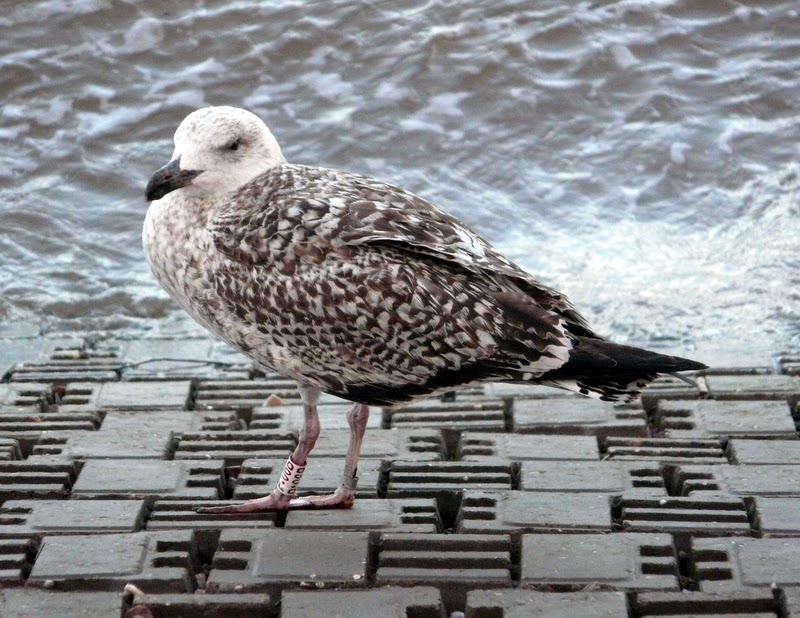
Colour-ringed Great Black-backed Gull


This first-winter bird is hanging around by the Imperial rugby ground beside the river. I'm guessing it's a Portland-ringed individual but will try and find out. Lee if you're reading this can you shed any light? I notice on the Dawlish Warren blog that they have recorded Portland and northern France birds recently. Notice,  from the lower photo, how difficult it is to read the darvic ring, even at close range - full credit to Lee and the Warren lads for putting in so much time and effort into reading colour rings - I'm not that patient I'm afraid.
Also this morning this pied wagtail allowed a close approach - I absolutely love this species.


Another 45 minute dawn sea-watch off the raised beach huts produced the 2 female eider, 55+ gannet, 15 auk sp, 9 common scoter, 6 kittiwake and 6 diver sp that probably comprised all three species but all were picked up as they were heading away from me and were distant.
On a family trip back to Torquay this morning we managed to squeeze in a quick walk around Hope's Nose where 8 great northern diver were sheltering in the bay.


great northern diver - Hope's Nose - check out the white-looking bill - too much sun bouncing off it!

Evening update - many thanks to Kev and Lee for getting back to me so quickly. The GBBG was ringed on 28th of June this year, in Portland Harbour, by Terry Coombs. It has been seen at the Warren on at least four occasions in the last few weeks.
On a less pleasing note it turns out we were just a bit early for a black guillemot at Hope's Nose this morning. I did have the strong urge to sit down with the scope and do some proper birding there this morning but didn't have the scope and didn't have the time - c'est la vie!

Sunday, 22 December 2013

Orcombe

I spent fifty minutes, from first light, seawatching from the raised beach huts just beyond the lifeboat station. Birds seen were 3 red-breasted merganser, 2 female eider, 14+ gannet, 12+ auk sp, 14 red-throated diver (all west), 15+ kittiwake, 1 great northern diver and 3 diver sp. I notice the Warren has been getting a single eider from time to time so I reckon these are different birds as they seem 'joined at the hip' every time I've seen them. Both were present yesterday too.

                               sketches of red-throated divers

                                            the long-staying female eiders

Divers are one of those groups that I sometimes find perplexing. Great northern and black-throated can be difficult in flight, especially when seen distantly or briefly. I find red-throats relatively straightforward as they habitually raise and lower their heads and they always look skinny. However a diver species this morning (great northern or black- throated) raised its head too but nowhere near the height of a red-throat. I find high-flying great northerns in the spring quite easy, their sheer bulk giving them a goose-like quality. Black-throats are the rarest of the three in Devon so I don't often get the opportunity to study and sketch them. As with any bird a lot rides on the quality and length of views.