Friday, 24 August 2018

Three Ospreys and Portland Ribbon Wave


Two of this morning's three Ospreys from the back garden. I was disappointed not to get all three in the same shot as they were circling close together when I first picked them up (click on photo to enlarge).
 
A light scattering of migrants on Orcombe this morning (0615 - 0810) included 2 Wheatear, 1 Willow Warbler, 14+ Yellow Wagtail (with at least 4 more in with cattle at Maer Farm), 7+ Tree Pipit, 1 Jay and 1 Spotted Flycatcher. An adult Mediterranean Gull was off Maer Rocks.
I got back home for some breakfast and set the scope up in the back garden. Three Osprey circling the river together at 0920 were a bit unexpected. Two then spent some time fishing off Mudbank. I suspect the third may have been the long-staying individual but that's pure speculation, based on the fact that there was plenty of interaction between the three as I watched them. Also adult Mediterranean Gull, 5 Whimbrel and a Greenshank off Mudbank today.
Yesterday an Osprey was off Mudbank at around 3pm. Also off there 1 Greenshank, 7+ Whimbrel and 1 Mediterranean Gull. Late in the evening c30/40+ Common Tern came in to roost on Cockle Sands and 3 Gadwall off Mudbank was an unusual summer record. A Yellow Wagtail flew over the house in the morning, and at least 6 were watched in with cattle at Maer Farm.
 

Two Wheatear seen on Orcombe this morning. Above and below are the same bird.


Portland Ribbon Wave - Bristol Schools Camp - found resting beside an outside light. I had 3 in the same place last summer. There's clearly a well-established colony here, of this formerly very rare moth.
 
 
Gadwall - present with 2 females late yesterday evening. Always a good bird in Exmouth. The Mallard flock currently numbers c100+ birds which is under half the number we normally get.
 
 
Adult Mediterranean Gull - white ring, right tarsus 33B6 I think but not certain.
 
 
Spotted Flycatcher - my first on Orcombe this autumn.
 
 
One of at least 4 Yellow Wagtails in with cattle at Maer Farm this morning. At least 14 went over Orcombe Point earlier on.

Wednesday, 22 August 2018

Spotted Crake


Spotted Crake - Otter estuary - a great find by Chris Townend. Can't ever see me getting one of these in Exmouth. Many thanks Chris. (click on photo to enlarge).
 
One of the big drawbacks of not year-listing, and rarely twitching, is that you can go years without seeing certain species. Spotted Crake is one of those species, and a quick check of my records revealed that the last one I saw was on August 30th 2005! That one was a South Huish, four days after my son's birthday, 'bagged' whilst  twitching the Thurlestone Least Sandpiper. My only other Spotted Crakes were on Bowling Green on 10/9/04 (and subsequently), my only self-found bird on the river Clyst on 12/8/99 and my first ever - a bird at Titchwell, north Norfolk (on a trip with Kev Rylands) on 13/9/96.
When Chris texted me with the news this morning I jumped straight in the car and headed over. I'm glad I did because the bird showed incredibly well - out of the vegetation rather than in it for the majority of the time I was there. It would have been nice if it was a little closer, but scope views were more than adequate - an absolutely stunning little bird and one that I just don't see enough of.
Exmouth has been exceptionally quiet today. A single Knot off Mudbank was noteworthy but that's about it.
Yesterday the juvenile Black Tern was still off the seafront, and on Orcombe I recorded 2 Wheatear and 2 Yellow Wagtails.

Monday, 20 August 2018

Osprey and Marsh Harrier


Osprey - Mudbank

Both Osprey and Marsh Harrier from Mudbank today. The Marsh Harrier was circling over the river, well upriver at about 1540, but my attempts to get it on the house list failed. It's presumably the juvenile bird that's been around a while. Likewise I'm guessing the Osprey is the long-staying bird, in which case it has taken me over a month to connect with it. Six Whimbrel were noted off there too.
Otherwise the Black Tern was off the seafront this morning, and this afternoon, and a brief early morning trip to Orcombe with Nick, produced c30+ House Martins over West, a fly-over Grey Heron and 2 Great Spotted Woodpeckers. No other migrants were noted, though there was a single Wheatear on the dung heap when I looked this afternoon.

Sunday, 19 August 2018

Seven Cattle Egrets


A disastrous attempt to photograph a fast-moving flock of Cattle Egrets, just after they'd rounded Orcombe Point. They headed towards the Warren and then presumably flew upriver. Despite the appalling quality of the photo note the dumpy structure created by a short 'front-end', short broad wings and short black leg/feet projection (click on photo to enlarge).
My only previous Cattle Egret finds in Exmouth were 2 birds in the Courtlands area in 2008, and a single bird in the estuary, off West Lodge, last October.
 
A brief sea-watch from around 0630 this morning produced way more than I was expecting. Best was a flock of 7 Cattle Egrets but a juvenile Black Tern, 30+ Common Tern, 5 Common Scoter, 7 Balearic Shearwater, 2 Mediterranean Gulls and 6 House Martins were also logged.
Off Mudbank today was 1 first-winter Yellow-legged Gull, 1 Redshank, 1 Greenshank, 5 Turnstone, 3 Whimbrel, c80+ Mallard and a juvenile Peregrine.

 
This magnificent first-winter Yellow-legged Gull was too far off for me to get a good photograph. It has replaced nearly all of its mantle and scapular feathers (click on photo to enlarge).

Saturday, 18 August 2018

Tree Pipit and Black Tern

 
Tree Pipit
 
The majority of Tree Pipits on Orcombe are early morning 'fly-overs', so it was lovely to be able to watch this grounded individual, which, going on the freshness of its plumage, is presumably a juvenile. Otherwise Orcombe was dead, but the juvenile Black Tern was off the lifeboat station early morning, and a small tern that headed straight out to sea looked good for a juvenile Arctic Tern. Unfortunately it was always heading away from me and I like to get everything on any juvenile tern species. Otherwise c20+ Common Tern and several Sandwich Tern were feeding offshore.
 

Yesterday on Orcombe a mini fall of migrants included 5+ Willow Warblers and my first Exmouth Sedge Warbler of the year.


Maisie has a job in a cafĂ© in Topsham so I have an excuse to pop into Bowling Green from time to time. Yesterday I had a look as the tide was coming in. The highlights were Green Sandpiper, Ruff, 2 Bar-tailed Godwit and c40+ Dunlin along with the usual stuff.


Wednesday, 15 August 2018

Dark Lesser Black-back - Edit


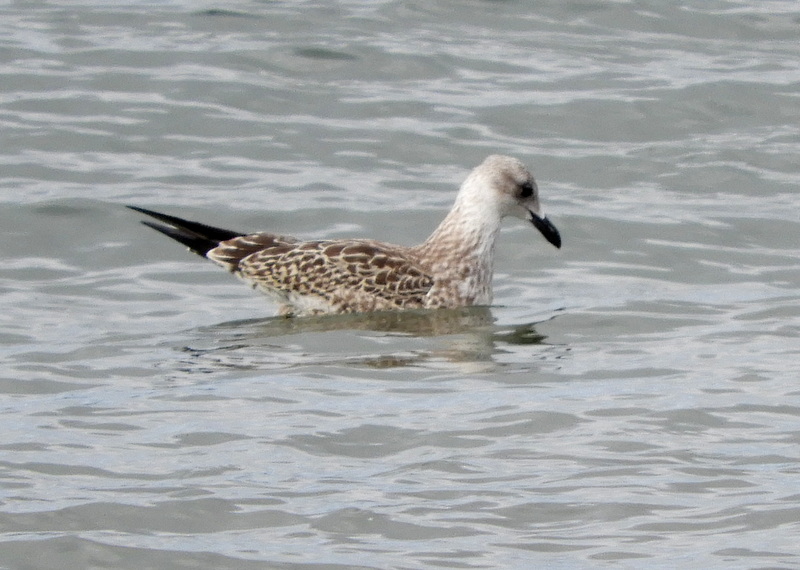
This dark juvenile Lesser Black-backed Gull was on Exmouth beach this morning. The overall darkness and dark bases to the greater coverts, forming a continuous bar, are features shared with Azorean Gull, but I'm not about to claim one here.  It has the required black 'shin-pads' of this species but so does the more typical Lesser Black-back below. The tertials look surprisingly well worn and the bird looks streaky below. Structurally the bird was a bit more Herring Gull-like than your more typical Lesser Black-back (again see below). Interesting bird.


Note the darkness of the upperparts and worn tips to the tertials. From what I understand, Azorean Gull retains its scapulars longer that Yellow-legged Gull, so wouldn't be expected to show signs of moult in the upperparts in mid August.


Azorean Gull shows a broad tail band (like Lesser Black-back and unlike Yellow-legged) and dark inner primaries much like that of Lesser Black-backed Gull, so nothing to suggest anything other than LEEB here, though the bases to the greater coverts form a continuous plain dark band, whereas in a typical LEEB the outer greater coverts tend to be dark based and the inners more patterned.


Edit - had overlooked this photo showing tail detail a little better (click on image to enlarge).

 
…..and some more photos to give a better idea of the bird's structure. There's some wear in the tail too.


This open wing shot shows a faint pale inner primary 'window', relatively short broad wings and almost solidly brown greater coverts. The outer web of T6 is white with small black 'indents'.
 
 
This is a more typical Lesser Black-backed Gull in both plumage and structure. It was also on the beach this morning. Note the outer greater coverts are dark-based and the inners are chequered. Also note the dark shin- pads.
 
 
Juvenile Yellow-legged Gull - no sign of any moult in the scaps on this one.
 

Six-striped Rustic


Dark form of Marbled Piercer, Cydia splendana


Orange Swift


Dark Sword-grass - 3 Silver Y and a Rusty Dot Pearl were the only other immigrant species.


Small Rufous


Flounced Rustic


Gold Spot


One of two Copper Underwing trapped last night.


Juvenile Marsh Harrier. I had a few things to do in Topsham this morning so I joined the crowds at Bowling Green. Spoonbill and Spotted Redshank seen amongst the usual stuff.

 
Juvenile Spoonbill

Monday, 13 August 2018

Garden Warbler and Golden-ringed Dragonfly


Believe it or not this is my first Garden Warbler in Exmouth this year. The patch of elders that I found it in is the most reliable spot for this species that I know of, however I'd never say that Garden Warbler is guaranteed in Exmouth in any given year. It was sharing the elders with at least 4 Blackcaps. Otherwise a single Willow Warbler was noted and a green-ringed Mediterranean Gull flew past Orcombe Point, towards the river mouth.
Mudbank was more productive with the juvenile Black Tern, 2 Knot, 2 Common Tern, c100+ Mallard, c10+ Whimbrel and a juvenile Mediterranean Gull on a brief morning visit.


A Golden-ringed Dragonfly is well camouflaged in Blackthorn scrub with accompanying sloes.