Tuesday, 11 March 2014

Garden Sibe Chiff

I was up and getting ready for work at first light this morning, so I took a mug of tea and the scope into the garden to have a look at the river. Almost immediately I could hear the flat piping 'hee' of a siberian chiffchaff. It was coming from the scrub at the back of the house that borders Warren View football pitch. Within a couple minutes I'd located the bird but I needed to get down on to the pitch to get the photo shown. It ticks all the boxes plumage-wise but it's always nice to get the call. It was silent for most of the time I was watching it and I'd have liked to have got a decent photo but I was up against the clock so I had to leave it.


Note the white underparts, strong super, dark legs, grey upper-parts and lime-fringed remiges - classic!

Sunday, 9 March 2014

Brant and Minor Migrant Success


For only the second time this winter I came across the black brant on Maer rocks. It was with 215+ dark-bellied brent geese at first light and a while later it had moved to the exposed rocks directly below Orcombe Point (still present at 9am). Black brants are funny birds - a tiny twist of the body and they can be a nightmare to pick out from dark-bellied brents, and at other times they stand out like a sore thumb. I took a selection of images but none come close to the shots obtained by Lee Collins at the Warren a couple days ago.


Straight forward side on - note the shorter neck, flatter back profile and more compact body. The bill appears shorter and stubbier and the bird seems to sit lower in the water.


Dark-bellied brents with Exmouth Beach behind. Nice early morning light.


Brent goose race - photo finish!


The above photo and the three below of the black brant were taken from near the Geoneedle looking down onto the rocks below.


Also today - 2 red-throated diver, 9 razorbill and 5 turnstone. Migrants were represented by 2 goldcrest, 1 yellowhammer, 1 chiffchaff (that moved through very quickly), 1 redwing, 4 song thrush, 12 pied wagtail, and 17+ meadow pipit. Yesterday the first stonechat of the spring, a male, and 21+ snipe. Yellowhammers are really scarce on Orcombe and spring records are more unusual than autumn records. As most do, today's bird flew over the top fields and followed the coast round towards the river mouth.
The estuary seems quiet at the moment but a single guillemot was way upriver with 9 black-tailed godwit and yesterday a great northern diver.


Several butterflies seen today. Many small tortoiseshell like the one above on Orcombe Point, plus at least one peacock and five brimstone whilst on a dog walk around Squabmoor Reservoir.


Drake red-breasted merganser off Shelly Beach yesterday evening. Soon the disparate groups on the river will merge to form displaying 'super-groups'. I've had single flocks of 90+ in March in recent years.


Fine weather brings nice sunsets on the river. At low tide you can walk right out into the estuary which is what I did last night. Few birds but amazing views.


Thursday, 6 March 2014

Quiet Week


First-winter black-headed gull.

A very busy week at work so far, so very little birding done. I popped home lunch time and got 2 sandwich tern, two pale-bellied brent geese, 2 great crested grebe and a drake goldeneye from Joel's bedroom window. This evening there was a great northern diver and a greenshank off the Imperial ground and there were at least 5 purple sandpiper and 1 turnstone on Maer Rocks. On Tuesday evening there was 1 long-tailed duck, 3+ great northern diver, c40/50+ common scoter and 2 eider off Maer Rocks plus a single sandwich tern off Exmouth Quay.


Another first-winter black-headed gull.

On Sunday I had a look at the Teign, hoping for a good gull. March always used to be a good time with ring-billed gull always a good possibility. I saw 15 ringers on the Teign in the space of around 10 years when I birded it regularly but I had no such luck on Sunday. I did see 77+ great black-backed gulls, 50+ common gulls and 8+ lesser black-backed gulls along with good numbers of herring gull but little else. I decided to try for some photos of gulls at Decoy but my plans were soon scuppered by some heavy drizzle.


Summer-plumaged (almost) black-headed gull.


Above and below adult winter black-headed gulls.


Above and below first-winter herring gulls.


Second-winter herring gull.


Adult lesser black-backed gull.

Saturday, 1 March 2014

Another Storm Casualty?


I walked the dog along the beach to Sandy Bay this afternoon and came across this shag tucked in under the cliff below Orcombe Point. I was able to get pretty close, which is a sure sign the bird is in a bad way. Whether or not it's due to the bad weather, that has caused the death of thousands of auks, I'm not sure as I've not heard of any other shag casualties. The bird was on a ledge so there was no way I was going to try and catch it. It did however give me an opportunity for some photographs - beautiful bird!


Good numbers of kittiwakes are back on the ledges of Straight Point. I counted at least fifty this afternoon but there appeared to be quite a few birds a little further out to sea.


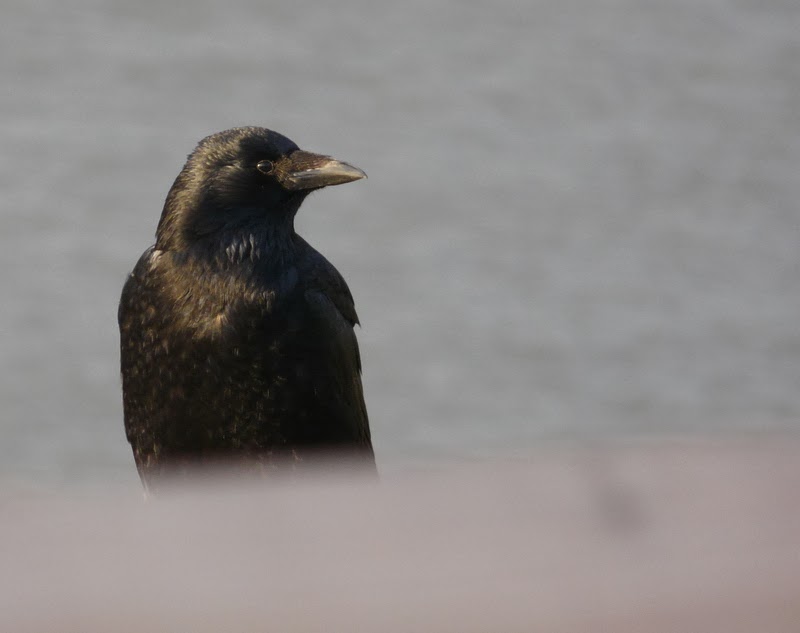
Carrion crow

Tuesday, 25 February 2014

Pale-bellied Brents and Odd Gull


I had a very enjoyable hour or so birding after work this afternoon. With the evenings drawing out the birding potential is definitely on the up! Off the Imperial this evening were three dapper pale-bellied brent geese - the first I've seen for ages. I'm assuming they are wintering birds that are normally elsewhere on the estuary as they normally move in the spring after the bulk of the dark-bellied brents have gone. There have been really high April counts on the Exe and they are now expected in numbers in the spring. Also this evening c80+, common gull, just 10+ lesser black-backed gulls and a smart adult summer mediterranean gull. A lone guillemot was drifting down river looking none too healthy and I counted 1 great crested grebe, 2 goldeneye and 35+ red-breasted mergansers.


The view from the coach park looking across to Cockwood with the Imperial rugby ground on the left.

I photographed this herring gull off Mudbank yesterday afternoon. There is nothing really at odds, plumage-wise, with it being a first winter herring but I feel a little uneasy about it. Firstly it has, in my opinion, a mild 'cachinnans' feel to it and I wonder if there might be some caspian genes lurking somewhere? The most odd feature is the paler 'band' across the greater coverts contrasting with darker bases. It's certainly not the classic 'cachinnans' pattern, or even close to it, but it's odd for herring gull too and I've seen photos of caspians showing patterning close'ish to this. Whether or not they are pure caspians of course remains open to question and even if this bird looked very like 'cachinnans' in other respects I think its wing coverts would rule out its acceptance as being pure. The tertials are worn and of little help and there are no pale tips to the median coverts that, on caspian, combine with the pale greater covert tips to give a double 'wing bar' effect. The bill is not great - quite short and a bit bulbous-ended and the head isn't gleaning white but it still feels a bit odd to me.


A bit of a bulge behind the legs in this shot but it doesn't look long-winged.


Note the smooth contour to the neck and the light neck streaking. The legs are not long and certainly not spindly and they are as pink as the herring gull to the rear.


I'm annoyed this is the only under wing shot I got and I missed seeing it properly in flight. You can't see anywhere near enough detail but it's not especially dark and neither does it look particularly pale. The overall feel is much more herring-like in this pose and the tail/upper tail coverts looks like bog-standard herring. I'd be really interested to see what anyone else thinks. Am I going mad or does it look a little unusual?

Sunday, 23 February 2014

Seawatch

I watched from the raised beach huts, near Maer Rocks this morning from 0725 - 0850. Totals included 5 gannet, 90 dark-bellied brent goose, 65+ kittiwake, 6+ red-throated diver, 13+ diver sp, 3+ great northern diver, 7 fulmar, 7+ common gull, 1 ad mediterranean gull, 1 eider, 1 long-tailed duck and 9+ common scoter. There were also good numbers of auks bombing around in the murk.


Good numbers of common gull are on the move at the moment. In the above photo a first-winter, adult winter and smart adult summer off Mudbank this morning. Lesser black-backed gulls are moving too with 24 off the Imperial rugby ground this evening. I photographed the great black-backed gull (presumed third -winter) below a couple days ago - a magnificent bird guarding its fish with vulture-like dominance. I'm guessing it's a male - compare the massive build with the accompanying first-winter bird.


Mediterranean gulls have been a bit thin on the ground of late. The last two I've seen have been picked up on call funnily enough. They get more vocal as spring approaches. The bird photographed below flew over me up at Hayes Barton Pig Farm. A distinctive 'keeaw'. I'm sure I'd have missed it had it not called!