Saturday, 16 February 2019

Quiet Still


Little Egret - Maer Lane - through a gap in the hedge. Love the powder-blue lores.
 
I've done very little birding this week. Not much seen today either but the three Eider were off Mudbank though distant, hauled out on Cockle Sands. Also off there - 2 Goldeneye, 80+ Wigeon and an adult Mediterranean Gull. The Lesser Black-backed Gull count remains steadfastly on nine birds.
A pre-football 'glance' off Maer Rocks revealed 1+ Purple Sandpiper, 6+ Turnstone and 80+ Dark-bellied Brent Geese.


Knot - Mudbank - earlier in the week.


Dunlin and Turnstone - Mudbank


Red-breasted Merganser - Mudbank

Sunday, 10 February 2019

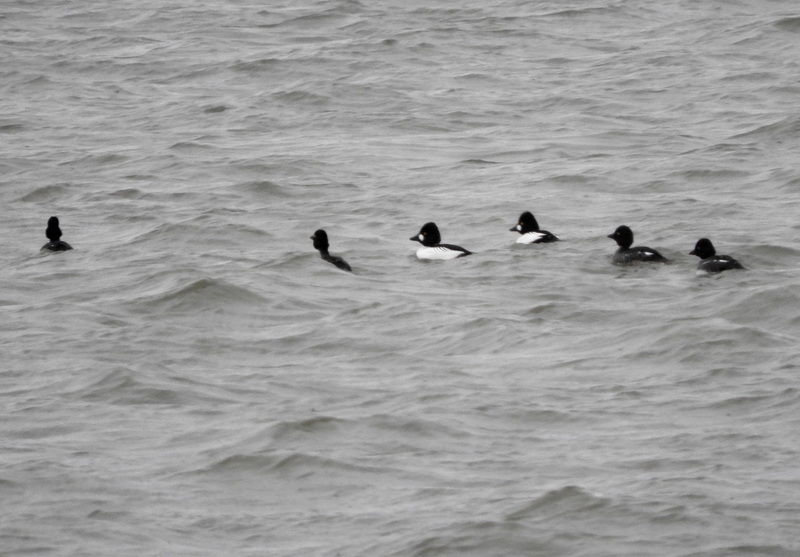
Goldeneyes


A frisky party of half a dozen Goldeneye off the Imperial this morning. Pity about the poor light and poor weather but an absolute joy to watch the males in full-on display mode.


Saturday, 9 February 2019

Bits and Bobs


Adult Mediterranean Gull - Mudbank
 
A quick sea-watch off Maer Rocks first thing produced 6 Great Northern Diver, 8 Red-throated Diver, 4 Fulmar, 1 Great Crested Grebe, c50/100+ Kittiwake, c50+ auk sp and at least 1 Razorbill - a species I somehow failed to record last year! A few Gannet past too.
Off Mudbank - a Mediterranean Gull and a dozen Pintail, and off Shelly Beach this afternoon - 3 Eider, 1 Slavonian Grebe and 9 Lesser Black-backed Gull which is a slight increase on recent counts.


Curlew - Lower Halsdon Farm


Raven - Colaton Raleigh Common


Crossbill - Colaton Raleigh Common - one of two over.

Friday, 8 February 2019

Eastern Black Tabby


A fantastic 'third for Devon' found by Nick last night, in Budleigh - a species I hadn't even heard of - Eastern Black Tabby! Nick did incredibly well to notice this tiny micro (Diplopseustis perierescalis) was something different - found indoors, it initially defied identification, but he soon sussed it out and very kindly popped round with it this afternoon. I haven't yet done much research but apparently Britain's first record was in 2001 on Tresco, Isles of Scilly, and the second was in Exeter in 2007. There have been records from southern Europe, and in particular the Canaries, but the species originates from the far east and Australia. It would be great to know which path had carried it to a living room in east Devon. Nick's new residence is proving to be a bit of a 'mecca' for rare moths.
Many thanks Nick - a tremendous find and superb piece of skill!

Monday, 4 February 2019

Black Red


The majority of cold weather refugees had cleared out yesterday, but this Redwing was one of half a dozen birds feeding with four Song Thrushes in fields at Lower Halsdon Farm. Also yesterday - the Velvet Scoter off the seafront in the afternoon, and two Mediterranean Gulls off Mudbank - an adult and a first-winter.
After work this afternoon the Black Redstart was flitting around the Shelly Beach area. It seems to only appear when the wind drops and the temperature rises.


The male Black Redstart was showing well around the sailing club late this afternoon.


Red-breasted Mergansers and Little Egret feeding together in the shallows off Shelly Beach.

Saturday, 2 February 2019

Golden Plovers


Golden Plovers - Orcombe Point
 
I didn't make it out until late afternoon after work yesterday, but the fields at the top of Gore Lane were jam-packed with birds escaping from the snow-covered hills - chiefly hundreds of Redwings and Fieldfares, but also 8+ Golden Plover and c200+ Lapwing alongside the 300+ Linnet flock and c100+ Skylark.
It was bitterly cold up there at dawn this morning but again alive with birds with several hundred Redwing, smaller numbers of Fieldfare, 125+ Golden Plover and c4/500+ Lapwing. On the dung heap were c5/10+ Meadow Pipit, 4 Rock Pipit and a Grey Wagtail. A Peregrine was causing havoc up there amongst everything and at least one Bullfinch was knocking around. On Maer Rocks - 5 Purple Sandpipers.
I had a bit of time out before and after work on Tuesday logging 4 Red-throated Diver, 51 Brent Goose, 4 Great Crested Grebe, c12+ Common Scoter, 3 Pintail, 1 Fulmar, 4 Purple Sandpiper and c150+ Gannet off Maer Rocks.


Lapwings - not sure about numbers on or over Orcombe this morning but estimated 4/500+ birds. Flocks were moving north by the time I'd popped down to Maer Rocks.


One of eight or nine Golden Plover in the top fields late yesterday afternoon.

 
Langstone Rock from Exmouth seafront late yesterday afternoon.

Friday, 1 February 2019

Falcated Duck


First-winter Falcated Duck - photo taken from Exmouth Leisure Centre on 18/11/06.
 
Mark Bailey kindly texted me at lunch time today with news that the BOU has added Falcated Duck to the British list. This is big news for me personally because back in November 2006 I found a first-winter drake in Exmouth - just off the leisure centre. It turned up at roughly the same time as the nearby Long-billed Murrelet and generated a lot of interest, both locally and from further afield. It was in with a large Wigeon flock and showed no signs of having been in captivity, but went straight onto category D of the British list and has languished there ever since. Of course the Devon individual hasn't officially been accepted as wild yet, and it may not be, but the drake in Norfolk and Northants in Dec 86 - Apr 87 has made the grade as Britain's first, so at least the Exe bird now stands a fighting chance.
A male shot on Orkney in November 2000 was stable isotope tested and proved to have come from a long way east, but its exact origin couldn't be established. An article on the Devon bird published in Birding World (Volume 19 Number 11) summed up the species' occurrence nicely for me. It read:

'This 'ornamental' species is kept in captivity, of course, but is also highly migratory in he wild and surely also reaches Britain as a genuine vagrant; certainly this individual seems to exhibit excellent credentials for being wild. It has been associating with a known 'carrier species' which originates from the same breeding area (Wigeon), and showed no obvious signs of having been held captive. There is already an established pattern of occurrence for Falcated Duck in western Europe which is (allowing for the occasional escape) very much as would be expected for a vagrant Asian duck. In 1987, a distribution analysis was published in Twitching 1:21-23, and little has happened since to change the rationale of 20 years ago. The most convincing single piece of the jigsaw is that BWP (Cramp & Simmons 1977) mentions that a Dutch-ringed Wigeon has been recovered from 108°E in Irkutsk (north of Lake Baikal). Since the breeding range of Falcated Duck extends north and west of Lake Baikal (to 90°E), it is highly likely that the odd one abmigrates to western Europe amongst our regularly wintering Wigeon flocks. Now that Baikal Teal has been proven to reach Europe as a genuine vagrant (see page 397), there is even more reason to assume that Falcated Duck does too. Eds.'

The Devon Falcated Duck remained on the Exe until January 11th 2007 and I was amazed to re-find what was presumably the same bird at Countess Wear sewage works on January 30th 2008. It was last seen on May 4th 2008. One of its wings had suffered some damage and was ever so  slightly dropped, which may explain its protracted stay the second time round.


When I first found this bird it had me completely stumped. It was one of the most non-descript birds I'd ever seen. After a lot of head-scratching, and a chance read of a sentence at the back of a field guide, which likened female and juvenile Falcated Ducks to female/juv Pintail, the penny dropped and all the features fitted in to place. By the time anyone else saw it, it had moulted a bit more and was looking more obvious. It remains my most difficult identification conundrum to date and it's one I'm still quite proud of.

 
Having originally favoured the south end of the Exe this bird followed Wigeon to the north end. These field sketches were made on the 1/1/2007 at Exminster Marshes.
 
 
Falcated Duck - Exminster Marshes.
 

Falcated Duck - Countess Wear 2008 - the pool this bird frequented was inside Countess Wear sewage works but it was sometimes visible from the Exeter Canal towpath. It was associating with Gadwall and its left wing was slightly dropped.