Monday, 24 November 2014

Black Red Yellow and Blue


A beautiful evening and a quick dog walk around the docks area after work. Good to find 2 black redstarts fly-catching from the, now not so new, 'new development' buildings. I'd much prefer some photos with wilder-looking backgrounds but beggars can't be choosers (and I do like the colourful buildings down there). Note the lack of white in the wing on the obvious male - presumably an immature bird. Interestingly the duller female-type bird shows a clear pale and extensive wing panel so is presumably also a young male. Probably need to do a bit of reading up on the subject!


Sunday, 23 November 2014

More Frustration

I checked Countess Wear sewage works this morning - an old favourite haunt of mine. I had a handful of chiffies and goldcrests on the way through but as I was walking back along the towpath, just past the two big oaks, I was stopped dead in my tracks. I could hear a clear disyllabic 'chu-vit' call, not too dissimilar to pied wagtail, coming from sallows just a few yards in front of me. I quickly got on the bird as it flicked around high up in the canopy of a large sallow, calling constantly - a 'yellow-browed' type going 'chu-vit' - has to be a 'humes'! I faffed around as usual, not sure whether to look at it through bins or film it with the camera and in the end I tried, rather embarassingly, to do both! Consequently I got no further beyond 'small wing-barred phyllosc' with the plumage and a minute of shaky video where all you can here is road noise from the nearby M5 flyover. I should have tracked it as it moved off but I once again reached for my phone and that was the last I saw of it. An absolute shambles!
I'm still hoping it gets re-found (there were a fair few people looking for it by the time I had to leave) but, unless it does, I just don't have enough on it for it to be acceptable to me as a find, never mind the BBRC. As with any rarity, you want to get all the features and allow them time to sink in and be enjoyed. I felt like this when I first had the Caspian Tern, back in August and it's not a nice feeling.
I'll definitely try and get back there next weekend.

Tuesday, 18 November 2014

Birding in Near Darkness


Pale-bellied Brent Geese - flushed towards the Warren by a paddle-boarder.
 
Only a few minutes of daylight available after work in the afternoons so little to report, but there were two pale-bellied brent geese off the Imperial this evening and 3 avocet yesterday evening - an uncommon sight this far down the river. Nearly all the wigeon and pintail have moved on (presumably upriver) but there are plenty of gulls coming in to roost, so there's still stuff to look at.


Dark-bellied Brent Geese with Lympstone in the background.

Sunday, 16 November 2014

Spoonbills


Heavy rain and thunder storms last night gave way to a reasonably dry dawn, though persistent rain set in a bit later on. Derek, Nick and I did the usual Orcombe circuit. The best bird was a single purple sandpiper feeding with 8 turnstone and a rock pipit below the point. It afforded good scope views and we didn't have to risk life and limb on seaweed-covered rocks, as is normally the case when the birds are on Maer rocks. There was very little moving overhead but what was moving seemed to be going east, and there was an obvious increase in thrush and robin numbers in the bushes. Totals included c60+ starling, 20+ song thrush, c20+ blackbird, c20+ robin, c20+ redwing, 8+ stock dove, 1 little egret, 3 reed bunting, 3+ bullfinch, 1 great northern diver, 1 goldcrest, c15+ chaffinch, 1 snipe, 2 grey wagtail and a small number of meadow pipits and pied wagtails.
On the way back home I had a quick look off the Imperial Rugby ground and almost immediately picked up 4 spoonbills out on the estuary. Scope views revealed them to be an adult with 3 juveniles. They were still there when I left but their little spit of mud had been covered and they were knee-deep in water as the tide crept in. No doubt they will relocate to the north end of the river. Also present were good numbers of dark-belled brent goose (no sigh of yesterday's black brant though), a small number of red-breasted mergansers, an adult peregrine and a slavonian grebe.


Feathered Thorn beside a light in the Bristol Schools Camp.
 

There was a noticeable increase in Robin numbers this morning. Song thrushes seemed to be 'sipping' from every hedgerow too.


Spoonbills with the sea wall off Starcross in the background.
 

Saturday, 15 November 2014

Black Brant


Oystercatcher off the 'Imperial'.
 
Nick and I did a quick scoot around Orcombe at first light, before a morning watching our sons playing football. The birding was a bit better than expected but there was nothing to get the pulse racing. Totals included 5+ pied wagtail, 1+ grey wagtail, 2+ redwing, 1+ goldcrest, c30+ goldfinch, c20+ meadow pipit, 5+ reed bunting, 6+ song thrush, 3 skylark, 10 stock dove, c900+ woodpigeon, c150+ starling and a lone oystercatcher. A quick stop at the Maer long-stay car park produced a chiffchaff and a water rail. Exmouth has successfully maintained its 'yellow-browed warbler exclusion zone' status!
This afternoon I had a look off Mudbank and the Imperial Rugby Ground and managed to pick up an adult black brant with a small group of dark-bellied brents. It seems to be the full ticket, with a complete white neck 'web' and a peculiarly angular-shaped head. It is presumably the returning bird from last winter. I would have liked a better look at it but a girl with a dog walked straight towards it (I thought it was pretty obvious I was trying to photograph it) and flushed it much further out on to the river. There was an adult pale-bellied brent goose off Exmouth Docks midweek.


Red-breasted Merganser off the 'Imperial'.
 

Little Egret - Imperial.


Adult Black Brant (second from left) off the Imperial Rugby Ground @ 1530.


Sunday, 9 November 2014

Snow Bunting and Black Red


Yellowhammer - it's been a good Autumn for this species on Orcombe. This individual was initially detected by its call, from deep in cover, but it quickly popped up to show itself before flying off.
 
A really nice November morning both weather-wise and bird-wise. Nick and I were on Orcombe Point from dawn and clear skies signalled some late autumn migrant movement. The best bird was a snow bunting that flew west at 0730. It was picked up by its repeated plaintive, clipped 'chu' flight call. A nervous few seconds ensued before we clapped eyes on it and there was relief all round as it flashed huge white wing patches, enabling separation from the very similar-sounding lapland bunting. It was presumably a male, showing so much white, and it represents the first definite record for Orcombe as I've had to let a couple 'probables' go.
Other species logged this morning included 10+ blackbird, 5+ song thrush, 2+ chiffchaff, 2+ brambling, c60+ chaffinch, c20+ meadow pipit, 5+ pied wagtail, 1+ redwing, c10+ greenfinch, 1 grey wagtail, c20+ goldfinch, 1 yellowhammer, 2 blackcap, c900+ woodpigeon, 1 great northern diver, 2+ reed bunting, 1 rook, 16 stock dove, c10+ skylark, 1 great spotted woodpecker and 3 starling.


Great Northern Diver heading high west.
 

Great Spotted Woodpecker


Chaffinch - a few overhead this morning and a few dropping down into cover.
 

A late morning dog-walk, from Orcombe to Sandy Bay, with the family produced good views of this raven and a second bird up on the cliffs, being mobbed by a pair of kestrels.
 

We found this thumb-sized invertebrate whist doing some beach-combing (along with 10 golf balls, several rubber gloves, lots of dead fish, loads of tin cans, a starfish and a number of sea-urchins). I've no idea what it is. The spines are really sharp. Any ideas? A very odd creature!
Edit - a big thank you to Andrew Cunningham for identifying this as a Sea Mouse! See 'comments' below.


Starfish
 

Black Redstart - Harbour Court, Exmouth Docks.
 
 
This afternoon I nipped out in search of black redstarts and found one almost immediately, fly-catching from roof-tops around Harbour Court. A decent pale flash in the wing presumably makes this bird an immature male but my views weren't great.


Little Egret - Exmouth Docks
 

This dead porpoise (I presume it's harbour porpoise) was on the beach between the lifeboat station and Orcombe Point last weekend. Its dorsal fin is missing so perhaps it was hit by a boat. A sad sight. To get an idea of its size compare with the footprints next to it.
 

Finally, a scenic shot of the Exe estuary from Mudbank last night.

Saturday, 1 November 2014

Woodpigeon Bonanza


Woodpigeons
 
 
Nick and I birded Orcombe from 0650 - 0940, but for much of that time we were rooted to the spot as wave after wave of woodpigeons powered north-west. The passage started soon after dawn with smaller flocks, but at its peak we estimated flocks of 2000 birds followed by 1500 passed high overhead. Counting was difficult to say the least. At first we were able to count reasonably accurately but as the flocks got bigger we had to accept there would be a considerable margin of error. That said, both Nick and I reckon that, if anything, we probably under-counted, so 16000 is almost certainly a conservative count.
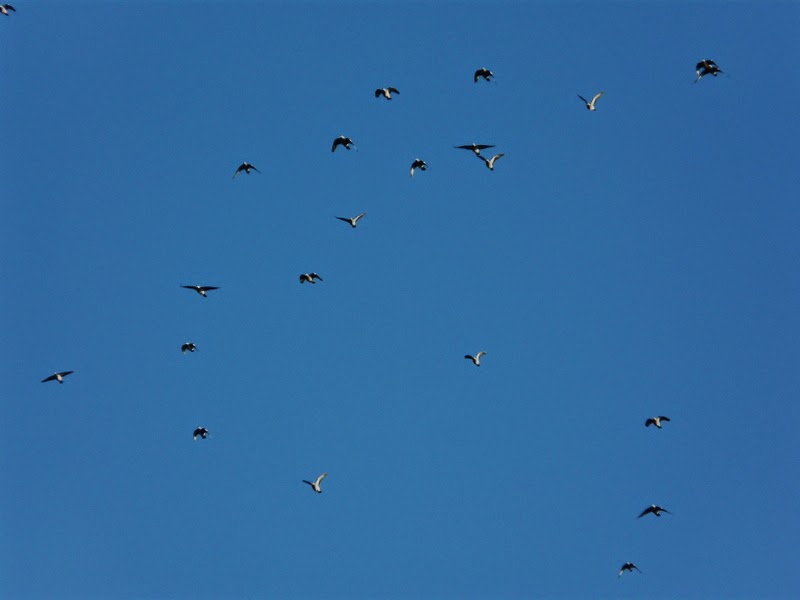
Photos can't convey the marvel and scale of woodpigeon migration and it was fantastic to hear the soft beating of hundreds of pairs of wings as lower flocks went over. Thankfully this spectacle is now expected every autumn in the right conditions.
Closer scrutiny of many of the less spectacular flocks revealed small numbers of stock doves. The biggest flock of stock doves consisted of 70+ birds. The total number of stockies recorded was 180+


17 Stock Doves
 
With so much pigeon movement, other birds went under-counted but the following species made it into the notebook: 1 great spotted woodpecker, 2 jay, c10+ pied wagtail, several meadow pipit, c50+ jackdaw, c30+ chaffinch, 6 redpoll sp, several goldfinch, 1 raven, 2 song thrush, 9+ reed bunting, a few greenfinch, c60+ starling, c30+ skylark, 2 chiffchaff, 1+ siskin and 3 snipe.


Jay and Magpie
 

Reed Bunting - I went back up to the top fields early afternoon, curious to see if there were still pigeons moving, but unsurprisingly they weren't. This reed bunting was sat quietly in the hedge alongside the slurry pit.