Monday, 30 December 2019

Still Quiet


Turnstones - Leisure Centre.
 
Yesterday morning early - 10 Red-throated Divers past Orcombe Point and off Shelly Beach late afternoon - 1 Great Northern Diver and 110 Common Gulls.
I've seen very little today but the two Black Redstarts were flycatching off apartments around Shelly Beach, making the most of the sunshine, and a female Goldeneye was off Mudbank. At least a dozen Cattle Egrets were in with cattle between Starcross and Cockwood, as viewed from Mudbank, and 40+ Pied Wagtails were joined by a couple Meadow Pipits on Exmouth cricket pitch.


Great Northern Diver off Shelly Beach yesterday.


Black Redstarts - Shelly Beach.


Green Woodpecker - Woodbury Common. Two long dog-walks in two days produced 3 or 4 Dartford Warblers (including two singing males), a handful of Reed Buntings, Crossbills, Redpolls and Siskins. At least one Red Admiral was zooming around.


Saturday, 28 December 2019

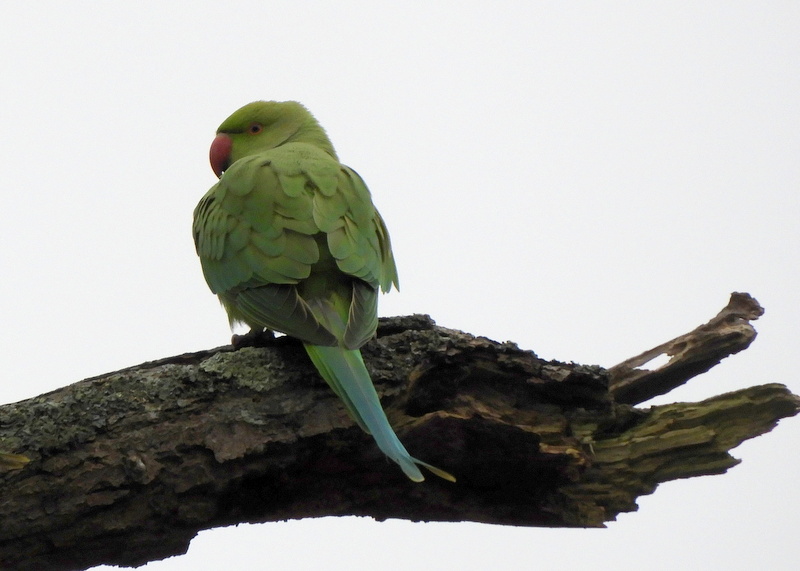
Ring-necked Parakeets


Female at a potential new nest site.
 
I spent quite some time watching six Ring-necked Parakeets at a 'new' site in Maer Valley this afternoon. The group consisted of five females and a male. It was fascinating to watch them strip bark from the tree and nibble on buds. I also heard some different vocalisations and witnessed some interesting social interactions, with birds nuzzling up to one another and apparently preening each other too. Great birds and nice to see some colour on an otherwise monochrome grey day.
Also in the valley - 20 Curlew, 1 Mistle Thrush, 5 Redwing and 3 Chiffchaff logged.


Five birds in this photo. Surprisingly well-hidden for a lurid-green bird.


This is the male. I was disappointed not to get a better shot.


A flock of 118 Black-tailed Godwits was off Mudbank this morning. Also off there - 2 female Goldeneye and 77 Mallard.

Friday, 27 December 2019

Christmas Period


Just three Purple Sandpipers visible on a very busy Maer Rocks late this afternoon. Also at least 6 Turnstone and a Great Northern Diver offshore.
 
Very quiet still in Exmouth. I had 5 Red-throated Divers past Maer Rocks early yesterday morning and on Christmas Day - 21+ Cattle Egret scoped from the garden (in cattle field between Starcross and Cockwood) along with a Ring-necked Parakeet flying around, somewhere behind Lower Halsdon Farm.
On Christmas Eve 3+ Red-throated Diver and a Great Northern Diver flew past Maer Rocks early doors, and a Firecrest was again seen in Liverton Copse, along with a Treecreeper.


Very little at Hayes Barton yesterday. A distinct lack of finches, gulls and corvids but a nice flock of 90+ Fieldfare, with a couple Redwing and one or two Mistle Thrush amongst them.
 
 
I walked the dog around Lympstone Common yesterday afternoon. Apart from a fly-over Crossbill and one or two Goldcrests it was very quiet, until I bumped in to the f*****g Gruffalo!!

Monday, 23 December 2019

Goosander and Cattle Egret


Dawn off Maer Rocks - 3+ Purple Sandpiper, 1 Knot, 2 Red-throated Diver, 1 Great Northern Diver and a surprise drake Goosander, in towards the Warren.
Off Mudbank - 2 Peregrine, 2 adult Mediterranean Gull (including a white-ringed bird), 5 Pale-bellied Brent Goose and a very distant Cattle Egret amongst a large cattle herd behind Starcross, later scoped from the garden and duly added to the house list.
 
 
 I had a stroll along the cycle track between Littleham and Budleigh this morning. Somebody has created a superb feeding station below the embankment, attracting at least a dozen Greenfinch, Nuthatch and several Chaffinch amongst other common stuff, as well as this Treecreeper whilst I was there.

Friday, 20 December 2019

Devon Flashback 18 - Red-throated Pipit


My first ever Red-throated Pipit was the Skern bird on May 4th 2003 (I'd dipped it the day before). A gorgeous bird that was well worth the cross-county twitch (twice). I was stunned at just how red the Skern bird was and my diary entry (which is way too long and waffly to include here) recounts how pleased I was to get it calling. Summer-plumaged Red-throated Pipits are a rare sight in the UK and this remains my only one, though I've since found two, less colourful, autumn birds on Orcombe Point. The first was on 23/10/09 and the second on 9/10/12.
I managed good views and a photo of the first one, but the second one played 'cat and mouse' in stubbles on a very wet morning, and I never got decent views. The repeated calls given as it flew around with Meadow Pipits were enough to clinch it and get it accepted by the DBRC though. RTP has since been reinstated as a BBRC rarity.
 

Skern bird.


My first 'self-found' RTP on Orcombe Point  -above and below.


I was pleased to get this photo, after a lot of chasing, as the bird sat up in the hedge. Initially attention was drawn to it by its distinctive, drawn-out wheezy call. Note the brown-toned crown and ear coverts, and heavily-streaked flanks.
 

Thursday, 19 December 2019

Devon Flashback 17 - Franklin's Gull


Mark Bailey found this little beauty on December 16th 2000. He found it on Clennon Valley playing fields and I twitched it the following day, adding it to my Devon list, along with many other Devon birders. It put in a long stay, being last seen on the Teign estuary on April 21st 2001 which, at the time, was still a site that I was watching regularly. I've seen only one Franklin's Gull since - a first-winter on the Hayle estuary, Cornwall on 3/3/07.
Here's my logbook entry for December 17th, 2000:
 
I had a call yesterday, whilst birding Countess Wear, from Tom Whiley. He told me that Mark Bailey had had a Franklin's Gull at Clennon Valley. I dashed down yesterday and spent a damp afternoon wandering aimlessly around Torbay, at times with Tom. I was half hoping it wasn't seen today because I'd promised a day with Lu. We did a freezing car-boot at 7am - 10am and made a respectable £50 before buying some 'Barley-sand' paint for the hallways, stairway and landing. It was whilst painting, shortly before 2pm, that Mike's wife, Tanya phoned to say the Franklin's Gull was on the football pitch. Mike had seen it from his living room! This was just what I didn't want but Lu was fantastic, urging me to go. I very nearly u-turned on the way, realising the selfishness of it, but kept going.
I sped down there and made good time, but arrived at the cut-through beneath Mike's house to find empty pitches. A few gulls were dropping on to the pond but there were none in the pool on the pitch where Mike had seen the bird. I scanned the pitches but just saw Colin Bath on the raised pitch, apparently not watching anything but talking to a blonde lady who was using a mobile. I noticed someone staring through a scope from the YMCA carpark, but as far as I could see there were just two Herring Gulls on the raised pitch. No small gulls at all. About 10 minutes later, a man and his son walked quickly towards Colin who let them look through his scope after pointing somewhere! I soon realised that they were watching what was presumably the gull. Unbelievably they were watching the Franklin's Gull that that had been totally invisible from my position, in the corner.
I enjoyed prolonged views before I left, returning to Exeter for 345pm - well-satisfied!
 
Although this was a Devon tick, it wasn't my first Franklin's Gull. A couple year before I'd birded Texas with Tom Whiley, and we managed to dig out at least two adults amongst a big flock of Laughing Gulls, at Galveston ferry port. My field notes of one of those pink-tinged birds from 17/4/98 are below:


Mark's Franklin's Gull was initially found on Clennon Valley football pitches but Mike re-discovered it off Goodrington on 19/1/01 and it later moved to Hope's Nose, where I saw it again on 31/3/01. Later that same day I picked it up on the Teign estuary. My logbook entry and notes for the 31/3 are shown below:
 
Following a report of a possible Laughing Gull, I got to Hope's Nose to find the 'Paignton'  Franklin's Gull, feeding on the outfall. It fed in much the same manner as Black-headed Gulls, moving steadily over the effluent, picking food from the surface and foot-paddling, tern-like over the surface. Occasionally it landed on the water and sat with the Back-headed Gulls. We watched the bird until it disappeared at approximately 130pm?
I  left to bird the Teign estuary and at some time between 3 and 4pm I relocated it out on the mud, amongst a small string of Common Gulls. The bird was still present at 430pm at least. It appeared in every respect to be the same bird as that at Hope's Nose,just along the coast.
 

Wednesday, 18 December 2019

Devon Flashback 16 - Red-eyed Vireo and Icterine Warbler


My one and only Devon Red-eyed Vireo was the Dawlish Warren bird on November 4th 1996. A stunning find by Ivan Lakin, and one that I think is unlikely to be repeated, in an era when American passerines are turning up pretty much exclusively in the Northern Isles or the very far south-west of Cornwall/Scillies, unless you include Ireland of course. To get one on the Exe is nothing short of astonishing, although we did get an American Robin on Exminster Marshes!
My logbook entry for 4/11/96 reads:
 
A Common Nighthawk was seen by Will Wagstaff this morning, hawking insects over the M5, 500 yards north of junction 28 near Cullompton.
James(my brother) has had the car all day for work, and Kevin and I couldn't wangle a lift up, but the news was that the bird hadn't been relocated.
Shortly after lunch Kev phoned in a slightly panicked state, to say there was a Red-eyed Vireo at the Warren, found by Ivan. He shortly afterwards phoned to say there was a train from Newton Abbot to the Warren at 1357.
I met him at the bottom shop near Dyrons Leisure Centre (he's staying with Debs) and we walked briskly to the station, making it with about 5 minutes to spare. We phoned the line for exact directions and the train pulled up at the Warren at 1410. Another quick walk and we met John Gale who'd pinned the bird down in the sallows at the back of the pond. It was hopping around slowly, from branch to branch, and I had poor views before it flew off and couldn't be relocated.
Half an hour or so later it was re-found back in the same spot, and I had superb views down to about 10 yards as it hopped around in the middle of a 'woody' stand of sallows, with brambes at the base. On the occasions it sat out in the open I got the solid grey crown, black sub-lateral crown-stripe, white supercilium, black eye-stripe, dark grey legs, white underparts, sloping forehead and heavy bill.
In fight it looked fat and clumsy. It fed high-up in Birches as well, but seemed to favour lower down at about head height. It was good at getting lost.
Quite a lot of birders showed up, most having been up at Cullompton! John Fortey was at Hope's Nose. I think he'll be really p*ssed off!
 
The day before I'd been down to Lipson Vale Community College, in Plymouth, for my first (and last) Devon Icterine Warbler. Another amazing find, this time by Pete Aley, in the most unlikely of spots. My logbook entry for 3/11/96 reads:
 
I got soaked ,in awful weather, dipping the bird yesterday in the unlikely setting of Lipson Vale Community College grounds. I'd imagined the area of trees mentioned on the line to be a small clump, but it's a bloody great area of Sycamores, Oaks and large Hawthorns, covering a rather steep, muddy slope.
I didn't come close to seeing this bird, found by Pete Aley, yesterday. Today however, a small group of birders, standing just inside the wood, led Kevin and I to the Hawthorn bush that the bird was favouring. In fact it remained in the same bush for the entire hour we were there. Often out of sight for long periods however.
It was just slowly hopping about. At one point it gobbled up quite a large type of insect. It seemed to spend most of its time just sitting still, occasionally preening. When it hopped in to view it did show well - looking superb, just like in photos, with a humongous orange bill, strong yellow, short supercilium and distinctive peaked crown - more pronounced and crest-like when wind-blown. The yellow extended to the throat and the clean underparts had a faint lemon hue to them. The tail was comparatively  short and the under-tail coverts long. The legs were dark blue-grey and I once had a good clear view of the long, pointed primaries. The most striking feature, when visible, was the stunning whitish rectangular 'blaze' on the secondaries - hyper-obvious. There looked to be some lemonish fringes to other remiges, but I didn't pin-point exactly where.
The bird was quite stocky and pot-bellied. It's a much more striking bird than I'd expected, and I'm sure I wouldn't have too much trouble separating it from the rounder-crowned and plainer Melodious Warbler.
I had great views in the scope at down to about 12+ yards. The light wasn't brilliant but when the bird got in to the left-hand side of the bush the views were great. The tail appeared short and square but was in fact notched - see notes.
We searched Efford Marsh for the Yellow-browed Warbler that's been around, but scored only Firecrest!