Tuesday, 2 December 2014

Same Black Brant?


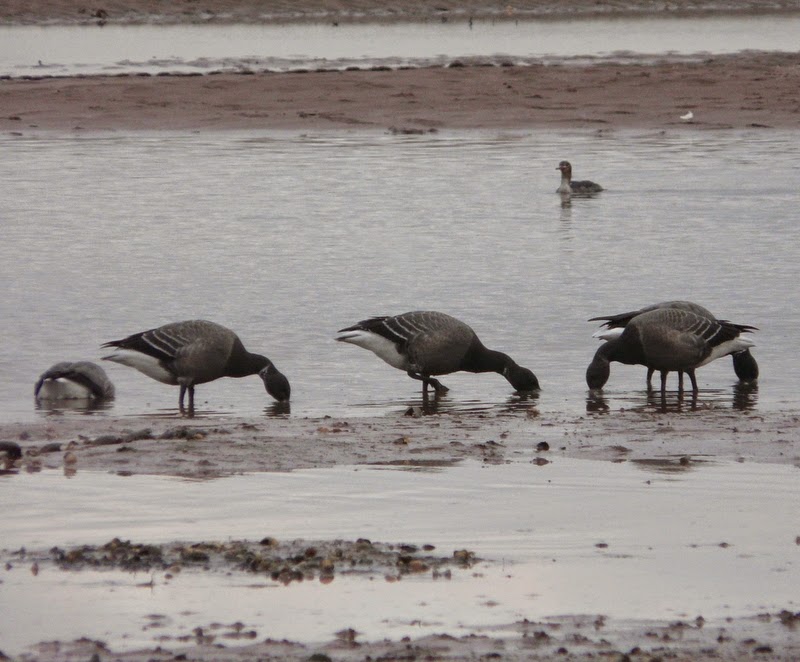
Adult Black Brant - photographed by Dave Boult at Dart's Farm - 1/12/14.
 
 
Dave Boult's superb photos (and video footage) of the Black Brant on the 'Devon Birds' website prompted me to make a comparison with photos of the Black Brant that overwintered on the southern end of the Exe during the autumn/winter 2013/2014. I focused on Lee Collins' stunning portrait of the bird taken at Dawlish warren in March of this year. Of course I fully expected them to be one of the same (black brants are known to show annual site fidelity) but to my surprise they appear to be different birds. I contacted Mike Langman who agreed they seem to differ, pointing out that the extent of white on the upper shoulder area differs markedly, being brighter and more extensive on the Dart's bird. Closer inspection of the white neck 'web' reveals a fuller, crisper pattern on the Dart's Farm bird and the Dart's bird shows a clear intrusion of black that curls up from the belly region into the white mid-flank. The Dawlish bird pictured below doesn't seem to show this, though caution is required here because the shape and pattern of the white flank patch can vary somewhat with posture. Mike suggested the tertials look longer and looser on the Dawlish bird, but with the caveat that this may be age related. It goes without saying that I would appreciate any comments, especially from those people who have seen either bird and/or photographed them, or from anybody with a knowledge of the moult/ageing of brants.
A big thank you to Lee Collins and Dave Boult for allowing me to use their photographs and, of course, to Mike for his thoughts on the bird.
 

Adult Black Brant - photographed by Lee Collins at Dawlish Warren on 7/3/14.


Little Egret flying to roost at dusk tonight - Mudbank.

 
Herring Gulls flying to roost.

Sunday, 30 November 2014

Fungi Twitch!


Red Cage Fungi - Exmouth.
 
I managed quite a bit of time outdoors today. Lu and the kids had friends over for much of the day so I made the most of it. I never thought I'd say this but the day's highlight was a couple incredible fungi. I had the good fortune to bump into Nigel Pinhorn, a superb naturalist and old mate, down at the sailing club. Nigel showed me a photo of these red cage fungi on the back of his camera and I was determined to have a look at them for myself. When I arrived, another fantastic naturalist and someone else I haven't seen in ages, Andrew Cunningham, was photographing them. If you walked past these you'd swear they were a kid's plastic toy - almost as big as a size 3 football and spongy-looking. Really, really weird!
Birding wasn't too bad today. I resolved to do some Exmouth sites early before doing Countess Wear after it had warmed up a bit. The farmer has finally cut the maize field at the top of Gore Lane and it was quite good. A quick circuit shortly after dawn revealed 3 golden plover, 9 snipe, c40/50+ skylark, 1 reed bunting, c5+ meadow pipit, c30+ linnet and c5+ chaffinch. There were 100+ dark-bellied brent goose and 3 turnstone on Maer Rocks. I scoped the drake long-tailed duck which was quite close off Warren beach and saw 2 black redstarts near the sailing club, though brief views suggested that neither were the 'paradoxus' male. Off Mudbank there was a female-type goldeneye and at least 11 great crested  grebes, along with the usual stuff, though both redshank and dunlin were present in higher numbers than usual.
Countess Wear was disappointingly quiet with c20+ redwing, 7+ chiffchaff, 1 water rail, 1 jay, 6 goldcrest and a grey wagtail the only birds of note.
This afternoon I took the dog and went looking for the great grey shrike on Colaton Raleigh Common but couldn't find it. At least 3 dartford warblers, a couple reed buntings, a fieldfare and several stonechat didn't quite make up for it but it was lovely up there all the same.
 

Good numbers of juvenile dark-bellied brents are mixed in with the adults off Shelly Beach.


Mute Swan - Countess Wear.
 

Lone Fieldfare - Colaton Raleigh Common.

Saturday, 29 November 2014

One Year Blogging


 'BirdingExmouth' has been running for exactly one year today. Many thanks to everybody who takes time to read it.


Two black redstarts around the sailing club today. Not a lot else.

Friday, 28 November 2014

Black Redstart - Paradoxus?


The first-winter black redstart of the presumed 'paradoxus' type again showing well around the sailing club this evening. It was frequenting the gable ends of the apartments down there, but also coming lower down on to the sea wall and getting in the tiny gardens and on the balconies. This form differs from the typical autumn grey female-types by having more advanced adult male-type head and body feathering and retained worn juvenile wings, lacking the striking white wing panels of adult males.
At least one purple sandpiper was with 5+ turnstone and a little egret on Maer Rocks late afternoon.


Thursday, 27 November 2014

Black Redstart Again


The view from Exmouth Quay tis evening. A rare glimpse of the sun on another grey November day.
 
I was keen to have another look at the immature male black redstart in the Docks area this evening. It was feeding along rooftops behind the sailing club until almost dark, loosely associating with a robin and a pied wagtail. The brown juvenile wings confirm that it is a young bird and there seems to be a hint of paler tips to the greater coverts. Nothing else about the plumage suggests that it is anything other than a bog-standard black redstart, though I can't remember seeing too many looking like this. It's a pretty good match for the illustration of an advanced first-summer male in the Collin's guide.


Immature male Black Redstart.


The back of Camperdown Terrace.

Tuesday, 25 November 2014

Abietinus?


Siberian Chiffchaff - Orcombe Point - 10/11/13 - a very grey 'fee'-calling tristis classic and my only record to date on Orcombe Point.
 
An interesting piece on Martin Garner's fantastic 'Birding Frontiers' website immediately brought to mind an interesting chiffie that I saw on Orcombe last year. The Scandanavian race of chiffchaff, abietinus is a bit of an enigma in Britain but they simply must occur. Any thoughts on the bird below?
 

An interesting chiffchaff photographed on Orcombe Point during the freezing spring of 2013. Photographed in the dung field on 24/3/13, it appeared very grey and white and tristis-like but note the yellow tones in the super and olive tones in the mantle. The call wasn't written down at the time but I'm pretty certain it uttered the typical 'hweet'. The grey collar on this bird is particularly arresting.
 

A typical colybitta-type olive and yellow bird photographed on Orcombe this autumn.


A Siberian Chiffchaff photographed in the back garden on 29/3/14. This bird always gave the bullfinch-like 'fee' call, perfect for tristis.

Purple Sands


Two purple sandpipers on Maer Rocks this evening - masters of camouflage.
 
I don't think I'll ever get a good photo of a purple sandpiper in Exmouth. The best time to get them is late in the day, when the weather is foul. This combination of timing and conditions is necessary, because if it's dry and the light is any good, Maer Rocks is usually crawling with people scouring the rock pools or just slipping around. This evening, after work,  it was raining steadily, cold and nearly dark. There were very few people on the beach and none on the rocks which is just what you need. The camouflage of these birds is absolutely superb and they can be quite easily overlooked. Also on the rocks this evening were 5 dark-bellied brent geese, 1 curlew and about half a dozen turnstone.